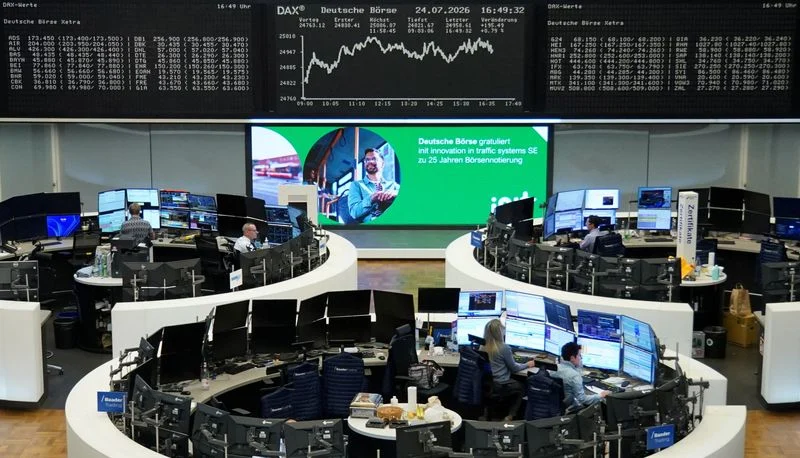
A look at the day ahead in European and global markets from Gregor Stuart Hunter
Government borrowing costs are rising to levels not seen in decades as the conflict in the Middle East worsens and investors fear the effect on inflation.
The yield on the 30-year Treasury bond hit its highest level since June 2007 on Tuesday, reaching an intraday high of 5.321%, as soft economic data prompted more traders to bet the Federal Reserve will refrain from hiking interest rates to curb inflation.
The prospect of higher energy prices – Brent crude is up for a third day at around $91 per barrel – alongside vague signals from the U.S. central bank over the path ahead spilled over into global fixed income on Tuesday.
The yield on the benchmark 10-year Treasury bond was up 0.4 basis point at 4.7259%, while corresponding Japanese government bond yields climbed 2.5 basis points to 2.945%, a three-decade high.
The rise in oil prices comes as a senior Iranian official told Reuters that Tehran would shift to a “fully offensive” military posture because efforts to negotiate a permanent end to the war with the U.S. have stalled. Washington ruled out extending a temporary ceasefire agreement that expired on Monday.
Underscoring the diplomatic strains, U.S. President Donald Trump also threatened to bomb Oman if they “get in the way” of negotiations around the future of the Strait of Hormuz. The Gulf state is the latest American ally to attract his ire this week, following South Korea and Canada.