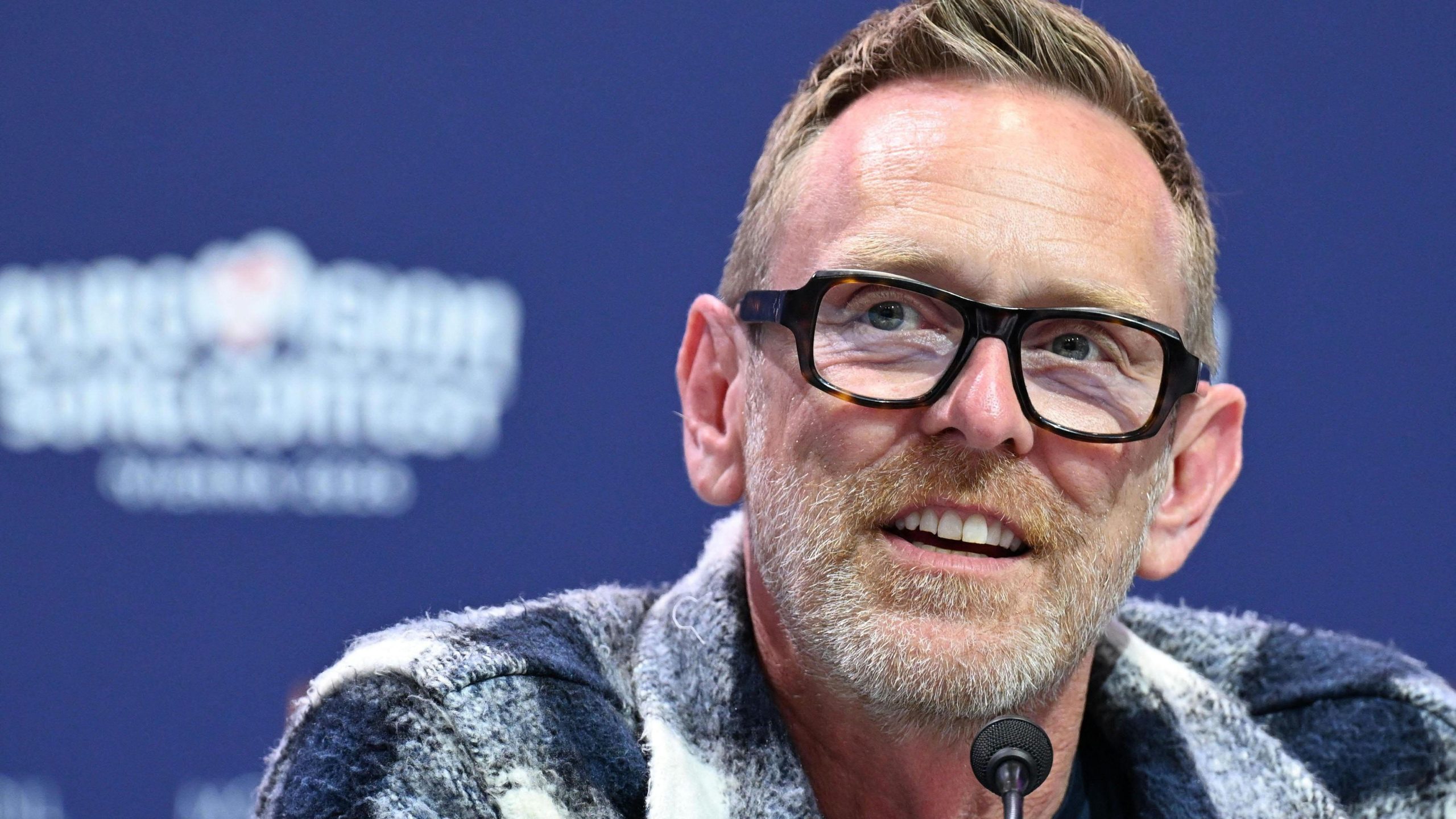
The director of the Eurovision Song Contest says organisers are watching voting patterns “very, very carefully” after concerns were raised about Israel’s ability to influence the results at last year’s contest.
Some broadcasters claimed that social media posts on Israeli government accounts, which encouraged people to vote multiple times, may have influenced the result.
Contest director Martin Green told the BBC he agreed that “some of the promotion by some of the broadcasters was a little disproportionate”.
The situation prompted an overhaul of voting procedures for this year’s event, and Green added that anyone who flouted the rules would come “under further scrutiny”.
‘Amicable resolutions’
The European Broadcasting Union (EBU), which organises the contest, has already issued a formal warning to Israeli broadcaster Kan after its contestant released videos instructing fans to “vote 10 times for Israel” last weekend.
Eurovision said it believed the posts weren’t in “the spirit of the competition”, and instructed that they be removed.
Asked whether the Israeli act could be disqualified for further breaches, Green said: “We’re a long way from any of that.
“If there is a problem, we start a conversation and we try and resolve it amicably, without reaching for sanctions,” he told the BBC’s Nomia Iqbal.
“We hope, in a way, that you teach the world that you can solve [conflict] by being collegiate right now.”
Israel were among the 10 acts who qualified for this year’s grand final from Eurovision’s first semi-final in Vienna, Austria, on Tuesday night.
However, voting figures will not be released for the semi-finals until after the main contest has concluded.
Questions were raised over last year’s results after Israel topped the public vote despite getting only 60 points from the national juries, who award separate scores based on a song’s compositional merits.
Israel received 83% of its points from the public, while the winner, Austria, got just 41%.
Media reports said an Israeli government advertising agency paid for online adverts and encouraged social media users to back the Israeli song, showing them how to vote up to the maximum 20 times.
The EBU said it had found no evidence of irregularities – but in November, it approved new rules that included halving the vote limit to 10, and discouraging “disproportionate promotion campaigns” carried out by third parties, including governments.
It has also made it mandatory for people voting online to provide credit card details to ensure that votes genuinely originate from the country in which they are submitted.
Jury votes have also returned to the semi-final stages of the contest. They had previously been dropped when it was discovered that six juries had traded votes at the 2022 contest in Turin, Italy.
Despite that, Green said he had confidence in the integrity of the current system.
“We are very consistent,” he said. “We have one of the best voting systems for the public in the world. It is fair, it is true, it’s secure.
“People can try and do what they like. They’re not going to [influence] anything.”
Will boycotting countries return?
Green has been director of the contest since 2024, after previously acting as the head of ceremonies for the 2012 London Olympics, and the chief creative officer of the 2022 Commonwealth Games in Birmingham.
In his tenure, the contest has been beset by protests over Israel’s involvement by contestants, fans and participants who object to the country’s military offensive in Gaza and the Middle East.
Last November, following a failed attempt to have Israel suspended, five broadcasters announced they would boycott the competition in 2026.
They included Spain, the Netherlands and Ireland, whose governments have been among the most vocal critics of Israel’s actions.
Speaking shortly before the first semi-final in Vienna, Green said he hoped the broadcasters would return.
“We’ve got 35 members of our family here, and that’s enough to have a big party,” he said. “But, you know, five [are absent] and we miss them.
“When this show is over, I know we’ll pick up the dialogue and we’ll see what comes.”